Introduction
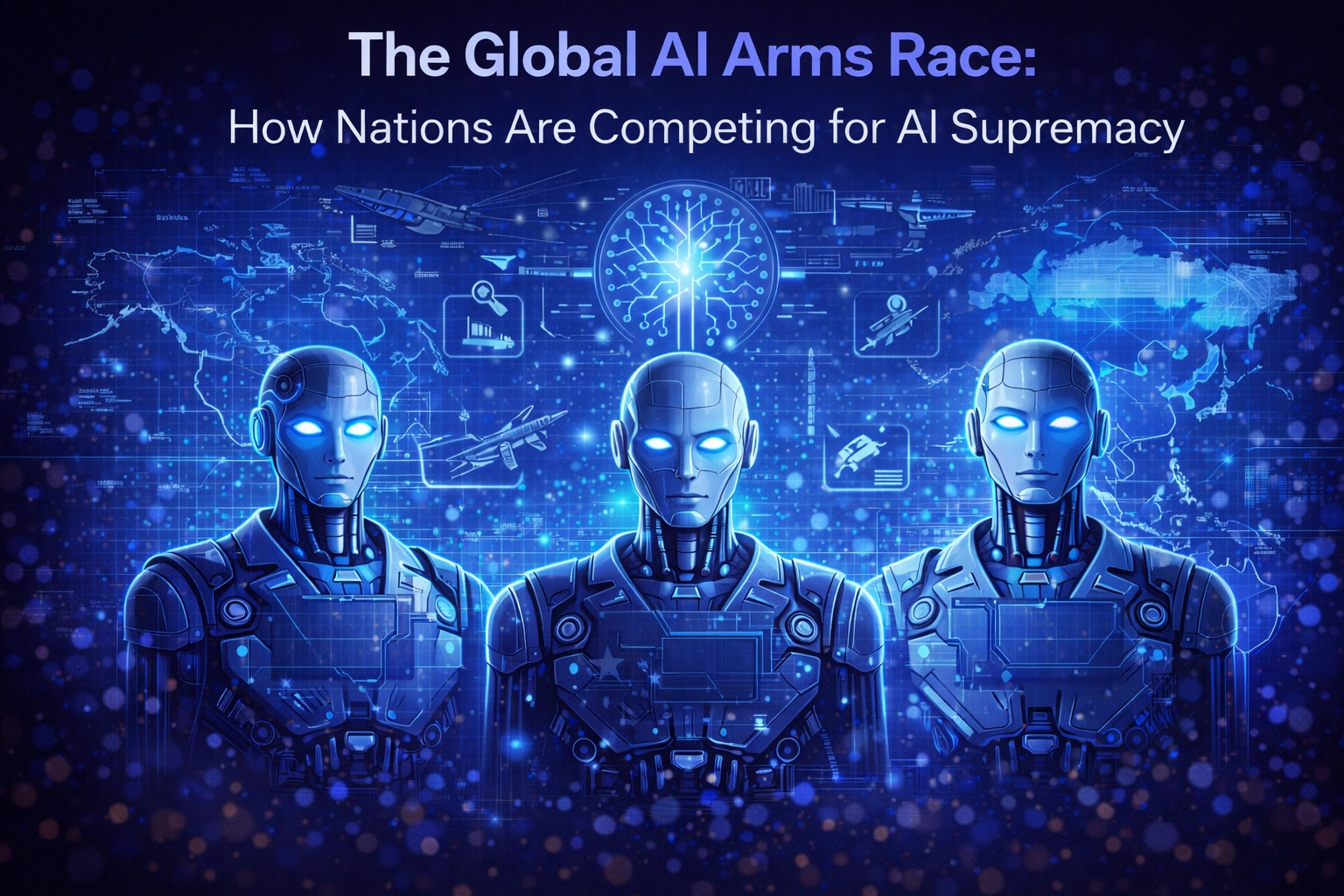
Artificial Intelligence has become the defining technology of the 21st century—and nations around the world are racing to dominate it. From military autonomous systems to economic dominance and surveillance infrastructure, the global AI arms race is reshaping geopolitics in ways that rival the nuclear age.
The Major Players
United States
Home to the world's leading AI companies—Google DeepMind, OpenAI, Microsoft, Meta AI, and NVIDIA—the US leads in private sector AI R&D. The Pentagon's Joint Artificial Intelligence Center (JAIC) oversees military AI strategy with significantly increased defense AI budgets.
China
China's 2017 New Generation AI Development Plan set an explicit goal: become the world's primary AI innovation center by 2030. With massive state funding, vast data reserves, and companies like Baidu, Huawei, and ByteDance, China is a formidable challenger.
European Union
The EU is pursuing a trustworthy AI strategy, prioritizing regulation and ethical governance through the landmark EU AI Act—the world's first comprehensive AI law. While Europe may lag in research output, it is leading in setting global AI standards.
AI in Military and Defense
Autonomous weapons, AI-powered cyber warfare, drone swarms, and battlefield decision-support systems are now central to military modernization strategies. The debate over Lethal Autonomous Weapons Systems (LAWS)—machines that can select and engage targets without human intervention—is intensifying at the UN level.
Economic and Technological Warfare
Nations controlling advanced AI chips (like NVIDIA's H100 and A100), proprietary models, and AI talent pipelines will dictate the terms of the global digital economy. The US-China semiconductor trade war—with sweeping export controls on advanced chips—is a direct front in this conflict.
The Risk of an AI Cold War
Experts warn that a fragmented global AI ecosystem—split between Western and Chinese AI stacks—could stifle international cooperation on safety research, amplify misinformation, and accelerate the development of dangerous autonomous weapons. International AI governance frameworks, akin to nuclear non-proliferation treaties, are urgently needed.
Conclusion
The race for AI supremacy is not merely a technological contest—it is a battle for the future world order. The nations that lead in AI will shape global norms, economic systems, and security architectures for generations. What is at stake is not just competitive advantage, but the question of what kind of AI-powered future humanity will share—together or divided.