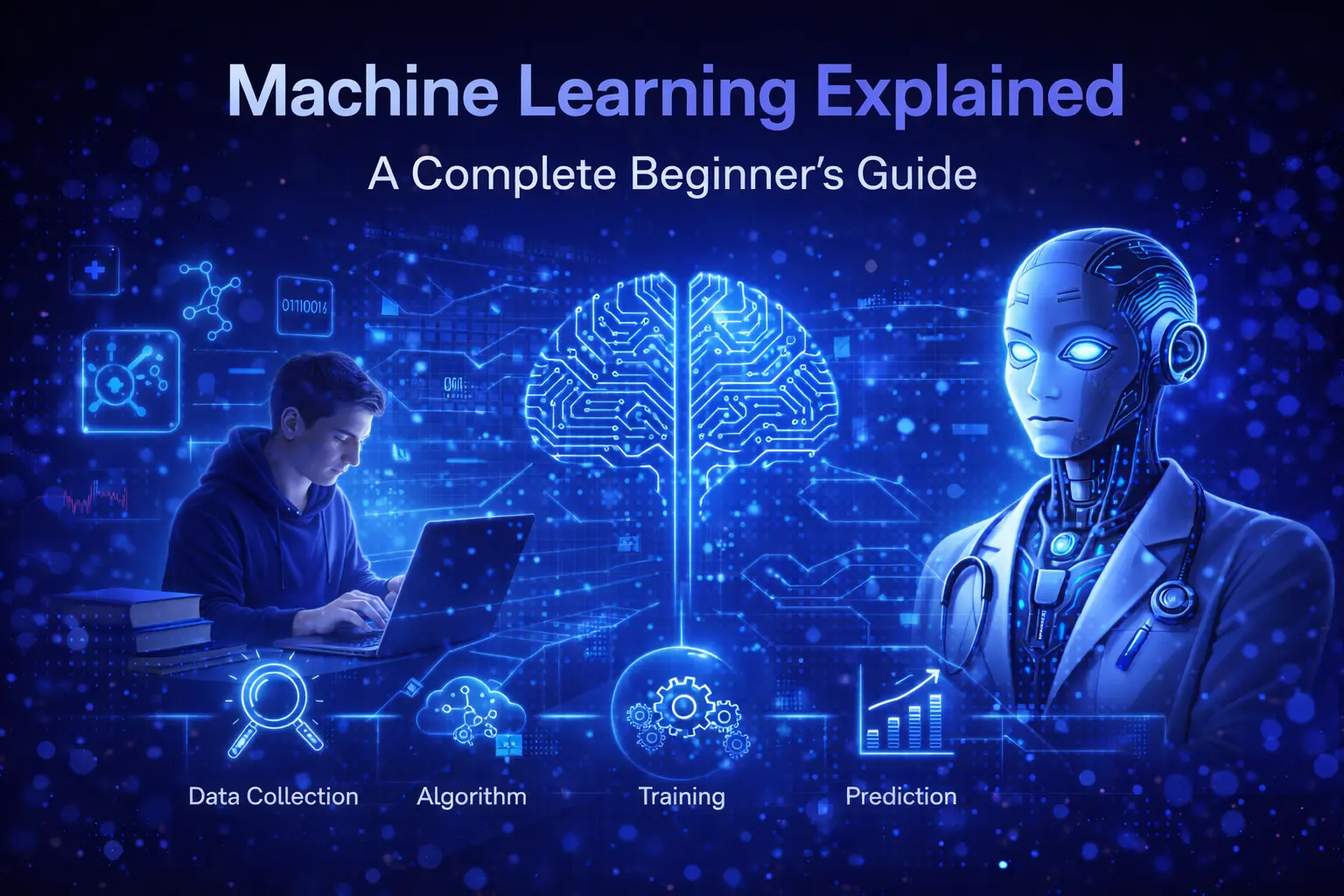
What is Machine Learning?
Machine Learning (ML) is a subset of Artificial Intelligence that enables computers to learn from data and improve their performance over time without being explicitly programmed. Instead of writing rigid rules, developers feed data into algorithms that discover patterns and make decisions autonomously.
Types of Machine Learning
Supervised Learning
The model learns from labelled training data. Examples include spam email detection, house price prediction, and image classification.
Unsupervised Learning
The model finds hidden patterns in unlabelled data. Examples include customer segmentation, anomaly detection, and recommendation engines.
Reinforcement Learning
The model learns by trial and error, receiving rewards for correct actions. It powers game-playing AIs like AlphaGo and autonomous driving systems.
Popular Machine Learning Algorithms
- Linear Regression – Predicting continuous values
- Decision Trees & Random Forests – Classification and regression
- Support Vector Machines (SVM) – High-dimensional classification
- Neural Networks & Deep Learning – Complex pattern recognition
- K-Means Clustering – Grouping similar data points
Real-World Applications
ML powers Netflix's recommendation engine, Tesla's autopilot, Google's search algorithms, fraud detection at banks, and voice assistants like Siri and Alexa. Nearly every technology product you use today has some form of machine learning embedded within it.
Getting Started with Machine Learning
Beginners can start with Python and popular libraries such as Scikit-learn, TensorFlow, and PyTorch. Free platforms like Google Colab and Kaggle offer hands-on datasets and notebooks to practice real ML projects at no cost.
Conclusion
Machine learning is not just a buzzword—it is the engine powering the modern digital economy. Whether you are a student, developer, or business professional, understanding ML fundamentals will be one of the most valuable skills of the next decade.